

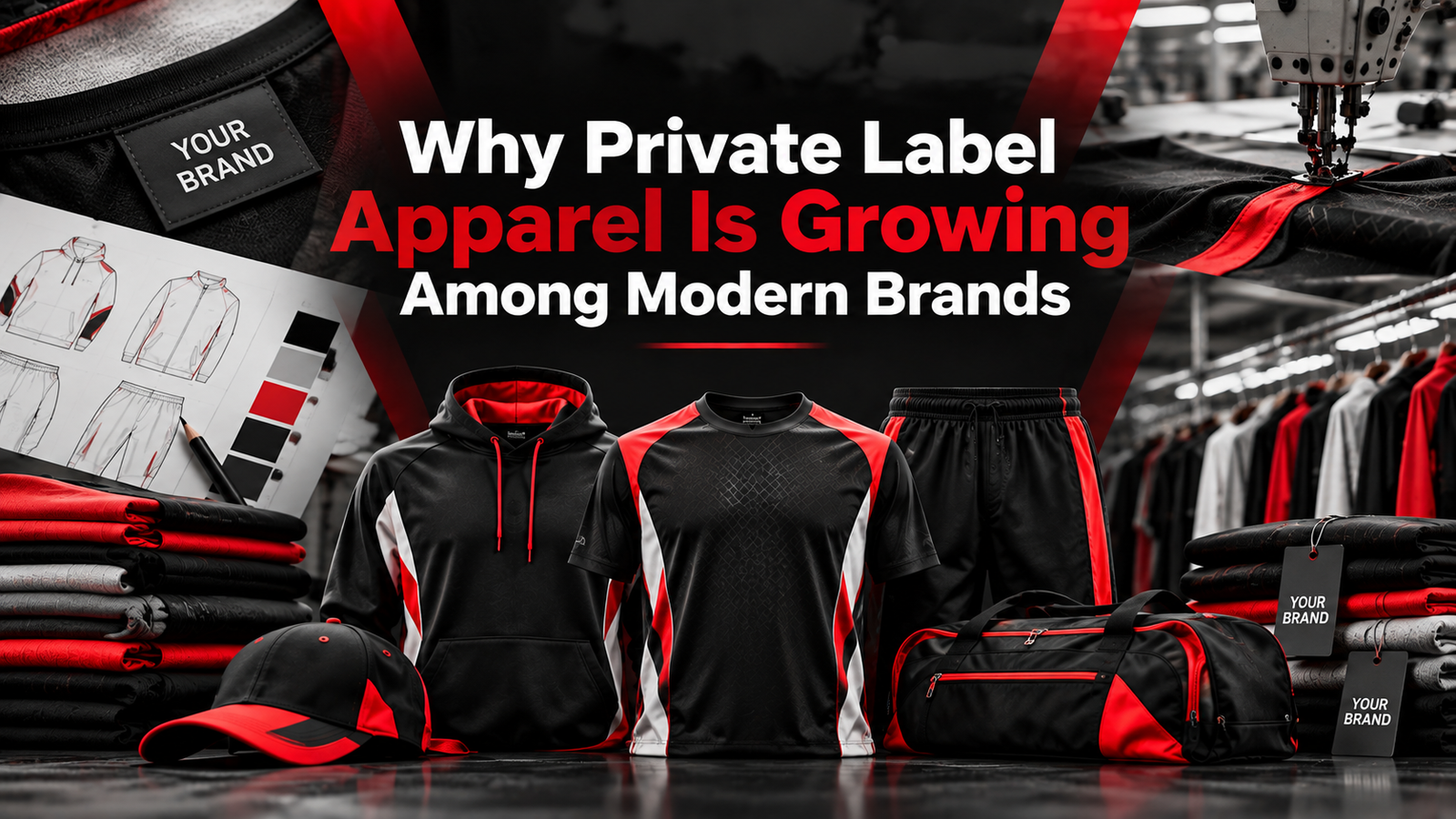
The modern clothing industry is increasingly driven by brand identity.
Customers are no longer interested only in the basic function of a garment. They also consider design, quality, fit, materials, presentation, values, and the identity represented by the brand.
This has contributed to the growing popularity of private label apparel.
Private-label manufacturing allows businesses to sell clothing and related products under their own brand instead of relying entirely on ready-made products carrying another manufacturer’s identity.
For entrepreneurs, retailers, e-commerce businesses, sports companies, and established fashion labels, this model can provide greater control over the products they offer.
What Is Private Label Apparel?
Private-label apparel refers to garments manufactured for a business and sold under that business’s own branding.
The manufacturer handles production while the client develops the brand identity and product requirements.
Depending on the project, customization can cover many aspects of the product.
These may include:
- Product design
- Fabric
- Color
- Fit
- Labels
- Logos
- Embroidery
- Printing
- Packaging
- Hangtags
- Product specifications
This gives brands an opportunity to create collections that are different from generic wholesale products.
Greater Control Over Brand Identity
One of the biggest advantages of private labeling is control.
When businesses purchase generic products, they are often limited to the designs, colors, fabrics, and branding already offered by the supplier.
Private-label manufacturing provides considerably more flexibility.
A brand can develop products around its own:
Logo → Colors → Design language → Fit → Materials → Packaging → Customer positioning
This consistency can make the overall brand experience much stronger.
Building a Distinctive Product Collection
Competition in apparel is intense.
Online marketplaces allow customers to compare hundreds of products within minutes.
Because of this, brands need ways to differentiate themselves.
A distinctive product collection can become a major competitive advantage.
Instead of selling the same generic hoodie as dozens of other businesses, a brand can develop a particular fabric weight, silhouette, color palette, artwork style, label system, and packaging approach.
The product becomes part of the brand rather than simply another commodity.
Private Label Is Not Limited to Fashion
Although private labeling is strongly associated with fashion, the concept extends across many product categories.
Businesses can develop private-label products for:
- Sportswear
- Fitness apparel
- Casual clothing
- Streetwear
- Martial arts
- Workwear
- Safety apparel
- Outdoor products
- Gloves
- Bags
- Accessories
- Teamwear
- Performance clothing
This flexibility makes private-label manufacturing relevant to many different businesses.
Developing Products Around a Target Customer
A successful private-label collection should begin with the customer.
Consider a sports brand targeting competitive athletes.
Its products may require lightweight fabrics, stretch, ventilation, ergonomic construction, and durable finishing.
A lifestyle brand may instead prioritize visual appearance, comfort, fabric texture, oversized silhouettes, and premium presentation.
A safety-focused company may require visibility, protective construction, durable materials, and practical storage features.
The manufacturing process should therefore reflect the intended customer and application.
Customization Creates More Opportunities
Private labeling becomes particularly powerful when combined with customization.
Instead of simply adding a logo to a standard product, brands can customize the actual product.
For example, a clothing business might develop:
- A custom fit
- Unique sleeve construction
- Special fabric combinations
- Custom color blocking
- Branded trims
- Signature embroidery
- Custom patches
- Personalized packaging
These details can make a product more recognizable.
Quality Is Part of the Brand
A private-label business ultimately puts its own name on the product.
That means manufacturing quality becomes directly connected to brand reputation.
If stitching fails, sizing is inconsistent, colors differ between batches, or materials do not perform as expected, customers generally blame the brand rather than the factory.
For this reason, quality control should be a central part of private-label production.
Brands should establish clear specifications and quality expectations before bulk production begins.
Sampling Before Bulk Manufacturing
Sampling is especially important for private-label products.
A sample provides an opportunity to evaluate the product before committing to a larger quantity.
Brands can review:
- Fit
- Fabric
- Color
- Construction
- Branding
- Artwork
- Measurements
- Finishing
- Packaging
Changes can then be made before production is finalized.
This reduces the risk of discovering major issues after a large manufacturing run.
The Importance of Consistency
A brand may successfully launch its first collection, but long-term growth depends on consistency.
Customers expect the next batch of a product to maintain the same general quality as the previous batch.
This means manufacturers need to work from accurate specifications and maintain consistent production standards.
For growing brands, maintaining product consistency becomes increasingly important as order volumes increase.
Private Label and E-Commerce
The rise of e-commerce has created significant opportunities for private-label businesses.
A brand can develop products, build an online store, market its collection through social media, and sell directly to customers without operating a traditional retail network.
This model allows businesses to test new concepts and build specialized collections around specific audiences.
However, online competition also means product quality and brand presentation matter more than ever.
Professional photography, packaging, product descriptions, sizing information, and consistent branding all contribute to customer confidence.
Choosing a Private Label Manufacturer
When selecting a manufacturing partner, brands should evaluate more than production price.
Important considerations include:
Manufacturing Experience
Does the manufacturer understand the type of products you want to develop?
Customization
Can the factory work with your designs, fabrics, branding, and specifications?
Communication
Are product questions and production updates handled clearly?
Quality Control
Does the manufacturer have processes for maintaining consistency?
Sampling
Can you review and approve samples before bulk production?
Scalability
Can the manufacturer support your business if your order volume increases?
These factors can have a significant effect on the success of a private-label collection.
Creating a Long-Term Brand
Private labeling should not be viewed simply as a method for purchasing clothing.
For ambitious businesses, it can become the foundation of a complete product strategy.
A brand can begin with a small collection, identify its strongest products, collect customer feedback, improve designs, and gradually expand into new categories.
Over time, the brand develops its own recognizable product identity.
Where the Industry Is Heading
The apparel market is becoming increasingly specialized.
Instead of trying to appeal to everyone, many successful brands are building focused collections for particular communities, activities, lifestyles, and professional requirements.
This creates opportunities for manufacturers that can provide flexible development and customized production.
Brands that understand their customers and work with capable manufacturing partners can build products that are more relevant and differentiated.
Final Thoughts
The growth of private label apparel reflects a larger shift in the clothing industry: businesses want greater control over the products they sell and the identity they present to customers.
Private-label manufacturing provides that control by allowing brands to customize products, develop unique collections, establish consistent branding, and build long-term product lines.
For businesses entering fashion, sportswear, lifestyle apparel, or specialized gear, the right manufacturing partner can make the process significantly more efficient.
TrolatSports supports brands with customized apparel and performance-oriented manufacturing, helping transform product concepts into professionally developed collections with a focus on quality, customization, and reliable production.